Skip to content

Recognition

The book, the front page, and the record

Credibility you can look up — not badges from a directory.

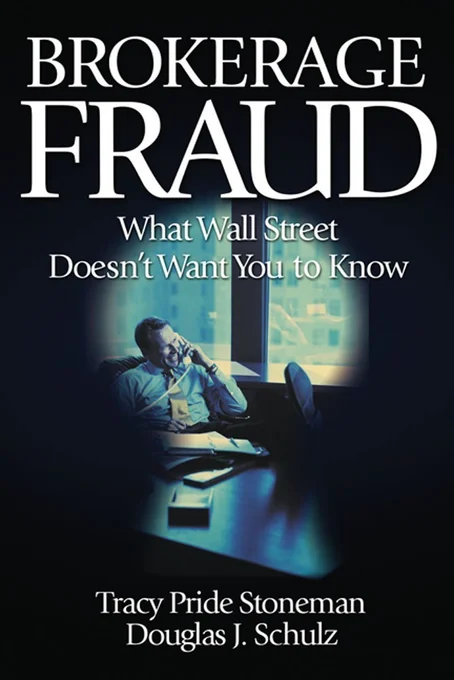
Brokerage Fraud: What Wall Street Doesn't Want You to Know — book cover
Dearborn Trade · 2002

The book

Wall Street’s least favorite bedtime reading.

Co-authored with my husband Douglas J. Schulz — a former stockbroker, compliance officer, and one of the country’s most sought-after securities expert witnesses — Brokerage Fraud walks through how the retail brokerage industry actually works: commissions and churning, sales targets and suitability, margin sellouts, annuities to wrap accounts. And what an investor can do about all of it.

Reviewers called it a wake-up call. One reviewer was a serving vice president of a major brokerage firm — and even he told readers to take our advice.

The reviews

In other people’s words

“That's why you might do a favor for any friends who still use a stockbroker by giving them Brokerage Fraud: What Wall Street Doesn't Want You to Know... they make enough of a case to get even very trusting investors to (wisely) think thrice about any broker's advice.”

— Robert Barker, BusinessWeek

“This book is a timely wake-up call to the brokerage industry to clean up its ways. Honest brokers have nothing to fear from this book.”

— Paul Taylor, Editor, Complinet

“Tracy Stoneman and Douglas Schulz certainly know what Wall Street brokerage firms wish you didn't. Even if the largest, most reputable firms are managing your money - and especially if you're working with a firm no one ever heard of - you owe it to yourself and your family to take the authors' advice.”

— Evan Cooper, Editor-in-Chief, On Wall Street

“What could well be the first truly in-depth examination of the many ways, and potential ways, that the investing public gets ripped off... In spite of its hard-edged tone, it really is a cookbook for a clean retail brokerage.”

— Lou Gorr, Inside Business

“The authors battle stockbrokers for a living... they make enough of a case to get even very trusting investors to (wisely) think thrice.”

— George D. Mullen, Vice President, UBS PaineWebber

The record

Things you can look up

The Wall Street Journal — March 1994

My Prudential Securities limited-partnership cases landed on the front page of the business section — because my clients were pressuring Prudential to offer higher settlements. It worked, and I obtained excellent settlements for my clients.

Kramer v. Smith Barney, 80 F.3d 1080 (5th Cir. 1996)

First case in Texas/federal court to hold that the six-year eligibility rule can be extended by proof of ongoing fraud or concealment — a victory for all investors, still cited against firms that claim the clock starts at the date of purchase.

PIABA — Board of Directors, 1999–2005

An early member of the Public Investors Arbitration Bar Association (since 1990), elected by fellow investors’ attorneys to six years on its board.

Judge & arbitrator

Former municipal judge (Cockrell Hill, Texas) and former NASD/NYSE arbitrator — I have sat where your panel sits, which changes how you argue to one.

Your move

A free evaluation has no downside other than your time.

Tell me what happened. I will tell you honestly whether you have a case worth pursuing — and every way I can be paid, including contingency: nothing unless you recover.